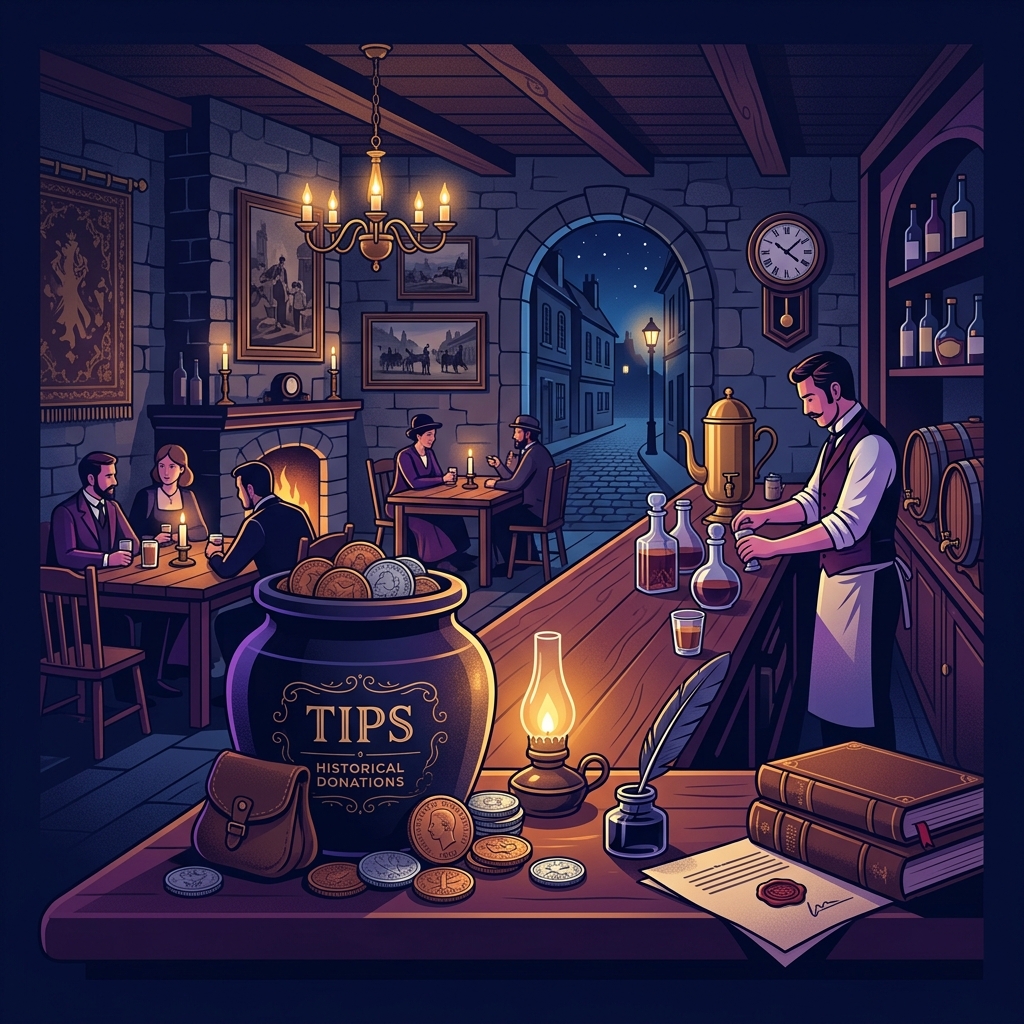
The Origins: Tudor England
The practice of tipping began in Tudor England (1485–1603), when overnight guests in private homes would leave small sums of money — called "vails" — for the host's servants. These payments were a way for wealthy visitors to thank the household staff who attended to their needs during their stay.
The word "tip" itself has debated origins. One popular theory suggests it came from "To Insure Promptitude" (T.I.P.), supposedly written on jars in English coffeehouses. However, most etymologists consider this a folk etymology. The more likely origin is the thieves' slang word "tip," meaning "to pass" or "to give," which dates back to the 17th century.
The Coffeehouse Era
By the 17th century, English coffeehouses — the forerunners of modern cafés — had adopted the practice. Brass boxes labeled "To Insure Prompt Service" sat on tables, encouraging patrons to drop in coins for faster service. Whether or not "T.I.P." is the true origin of the word, these containers certainly helped popularize the practice beyond private homes and into public establishments.
Coffeehouses were the social hubs of their day — places where businessmen, intellectuals, and politicians gathered. Tipping became a way to signal one's status and sophistication. Those who tipped generously received better seats, faster service, and warmer greetings.
Tipping Crosses the Atlantic
American travelers in the mid-1800s encountered tipping during visits to Europe and brought the custom back home, viewing it as a mark of worldly sophistication. Initially, many Americans resisted the practice, seeing it as fundamentally un-American and undemocratic.
"Tipping, and the aristocratic idea it represents, is what we left Europe to escape." — Anti-tipping advocates, early 1900s
Critics argued that tipping created a servant class inconsistent with American ideals of equality. The practice was seen as a form of bribery that undermined the principle that all customers should receive equal service regardless of their wealth.
The Anti-Tipping Movement
The early 1900s saw a fierce anti-tipping movement in America. Between 1909 and 1919, six US states passed anti-tipping laws, making gratuities illegal. Washington state imposed fines on both the tipper and the receiver.
William Scott's 1916 book "The Itching Palm" called tipping "un-American" and compared it to a form of feudalism. Labor unions opposed it because employers used tips as an excuse to pay lower wages. Despite this opposition, the laws were largely unenforceable and were all repealed by 1926.
Prohibition and the Rise of Tipping
Prohibition (1920–1933) inadvertently helped cement tipping culture. When alcohol was banned, restaurants lost their most profitable revenue stream — drink sales. To compensate, many establishments lowered staff wages and encouraged customers to tip instead, effectively shifting labor costs to diners.
After Prohibition ended, restaurant owners had grown accustomed to the lower labor costs. The tipping system was here to stay.
Tipping and Racial Inequality
The history of tipping in America cannot be separated from its racial dimensions. After the Civil War and the end of slavery, many formerly enslaved people found work in service industries — as Pullman porters, waiters, and domestic workers.
Employers used tipping as a way to avoid paying Black workers a regular wage. The subminimum wage for tipped workers — which still exists today at $2.13/hour federally — has roots in this practice. Modern tipping reform advocates point to this history as a reason to fundamentally restructure the system.
The Modern Tipping Landscape
Today, tipping in the United States has evolved significantly:
- Expected percentages have risen — from 10% in the 1950s to 15-20% (or more) today
- Tipping has expanded beyond restaurants to coffee shops, food trucks, and even self-service kiosks
- Digital payments have introduced "tip prompts" at point of sale, creating pressure to tip in situations where it wasn't previously expected
- "Tipflation" — the phenomenon of suggested tip amounts increasing (20%, 25%, 30% are common prompts)
- Some restaurants have experimented with no-tipping models, paying staff higher base wages instead
The Global Picture
While tipping has remained dominant in the US and Canada, the rest of the world presents a mixed picture. Japan considers tipping rude. Service charges are built into bills across most of Europe. Australia and New Zealand pay service workers living wages, making tips a genuine bonus rather than a necessity.
The ongoing debate about tipping reflects deeper questions about labor, fairness, and how societies choose to compensate service work. Whether tipping will eventually fade or continue to grow remains one of the most interesting questions in modern hospitality.
Calculate Your Tip Today
Whatever your stance on the history and future of tipping, the reality is that tipping remains an important practice in many countries. Use our free Tip Calculator to make the math easy — with bill splitting, currency conversion, and a comprehensive tipping guide for every situation.